Yes Bank AT1 bonds: what the Supreme Court ruling means for bondholders and depositors
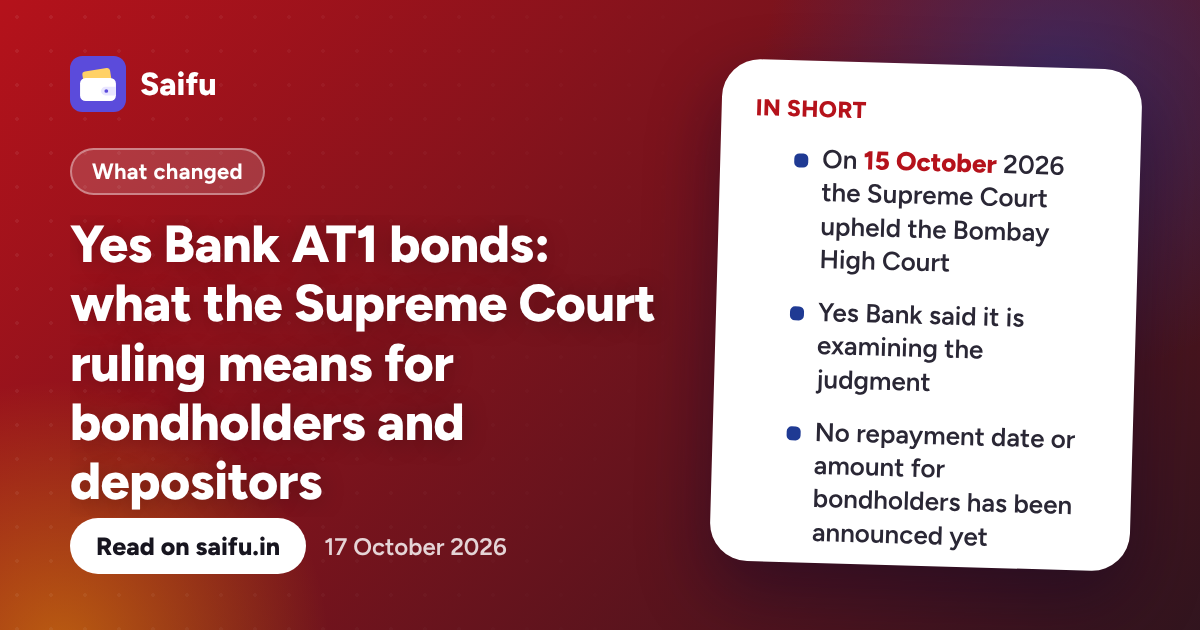
On 15 October 2026 the Supreme Court held the ₹8,415 crore write-off of Yes Bank AT1 bonds illegal. What it means for bondholders and depositors.
More than six years after Yes Bank wrote off its AT1 bonds, the Supreme Court has said the write-off was illegal. Many of these bonds were bought by ordinary savers, including retirees. Here is what the ruling means, and what it does not.
What the court decided
On 15 October 2026, a bench of Justices Dipankar Datta and Augustine George Masih dismissed the appeals of Yes Bank, RBI and the central government. It upheld the Bombay High Court's January 2023 order that had set aside the write-off of ₹8,415 crore of Additional Tier 1 (AT1) bonds, as reported by Sunday Guardian and Moody's on TradingView.
Yes Bank's administrator wrote the bonds down to zero on 14 March 2020, during the bank's rescue. Bondholders argued that the write-off did not follow the bank's final reconstruction scheme. The bondholders' lawyer told Reuters that the court found the write-off "illegal and arbitrary" because it went against that scheme.
We have not yet seen the full judgment on the Supreme Court website. The details here are as these publications reported them.
If you hold Yes Bank AT1 bonds
- The write-off no longer stands. The court has upheld the order that cancelled it.
- When and how much you get is not known yet. Neither Yes Bank nor RBI has announced how or when bondholders will be paid, or whether interest will be added.
- Keep your papers. Keep your bond purchase records, demat statements and any letters from the bank or the debenture trustee, Axis Trustee Services.
- Watch official channels. Yes Bank has said it will make disclosures to the stock exchanges. Anyone who calls to "help" you claim the money for a fee is likely a fraud.
If you are a Yes Bank shareholder
Yes Bank shares fell sharply on 15 October 2026. After market hours, the bank told the stock exchanges that it was examining the judgment, as reported by the Free Press Journal. On 16 October it estimated that paying the bondholders would cut its core capital (CET1) ratio by about 2.5 percentage points, as reported by Upstox. Saifu does not say whether to buy, hold or sell any share.
If you hold Kotak Medium Term Fund or Kotak Credit Risk Fund
Kotak Mutual Fund suspended new investments in these two debt funds on 15 October 2026, before the ruling, as reported by Goodreturns and Upstox. Both funds hold Yes Bank AT1 bonds that they had valued at zero since 2020. Kotak called it "a prudent measure to safeguard the interest of our investors" and said it is reviewing the judgment. It has not said when new investments will reopen or how the bonds will now be valued. The reports do not mention any limit on redemptions. If the bonds are paid back, the value would go to the people who hold units at that time, which is why the fund paused new money. Mutual fund investments are subject to market risks; read all scheme related documents carefully.
If you have a savings account or FD at Yes Bank
The case is about AT1 bondholders, not depositors. Your account and FDs carry on as before. Deposits at Yes Bank, as at every bank, are insured by DICGC up to ₹5 lakh per depositor, including interest. Yes Bank stays regulated by RBI.
What AT1 bonds are
AT1 bonds are a type of bank bond that counts as capital. They pay a higher interest rate because the bank can skip interest or write them off when it is in trouble. They are not deposits and are not covered by deposit insurance. In April 2021, SEBI fined Yes Bank ₹25 crore over how these bonds were sold to individual investors, as reported by Business Standard.
Sources: Goodreturns: Kotak suspends debt fund subscriptions after the AT1 ruling, Upstox: Why Kotak MF suspended subscriptions in two debt funds, Sunday Guardian: Supreme Court ruling on ₹8,415 crore AT1 bonds, TradingView (Moody's): Supreme Court upholds Bombay HC order quashing Yes Bank AT1 write-off, Outlook Money: Yes Bank shares fall after the AT1 ruling, Free Press Journal: Yes Bank says it is reviewing the judgment, Upstox: Yes Bank estimates 250 bps impact on CET1 ratio, Business Standard: SEBI fines Yes Bank ₹25 crore in AT1 bonds case, DICGC: deposit insurance.
Rules, rates and limits change. Check the official source linked above before you rely on a figure here. Last checked 17 October 2026. Posts never contain referral or affiliate links from the writer.
Want to write for Saifu? Here is how.